
WHEN POLICY COLLIDES WITH REALITY: COLLIE, COAL, AND THE COST OF GOVERNMENT INCOMPETENCE
A transition without coordination is not reform. It is failure in slow motion.

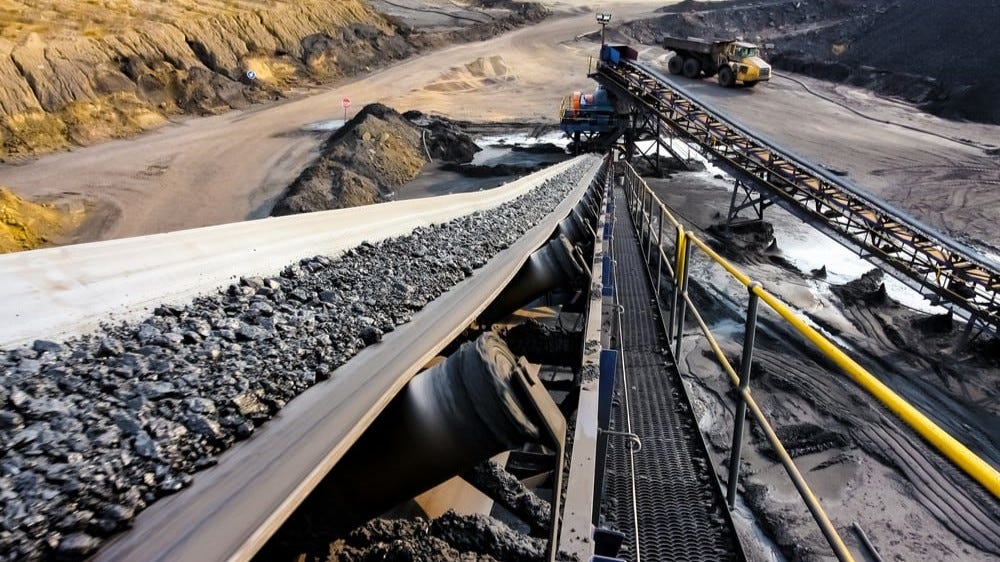
Collie Coal Mine (Image courtesy of Shutterstock)
In a week already marked by economic unease, punctuated by Australia’s national debt crossing the one trillion dollar threshold under the Albanese government, Western Australia has delivered its own case study in policy incoherence and administrative failure.
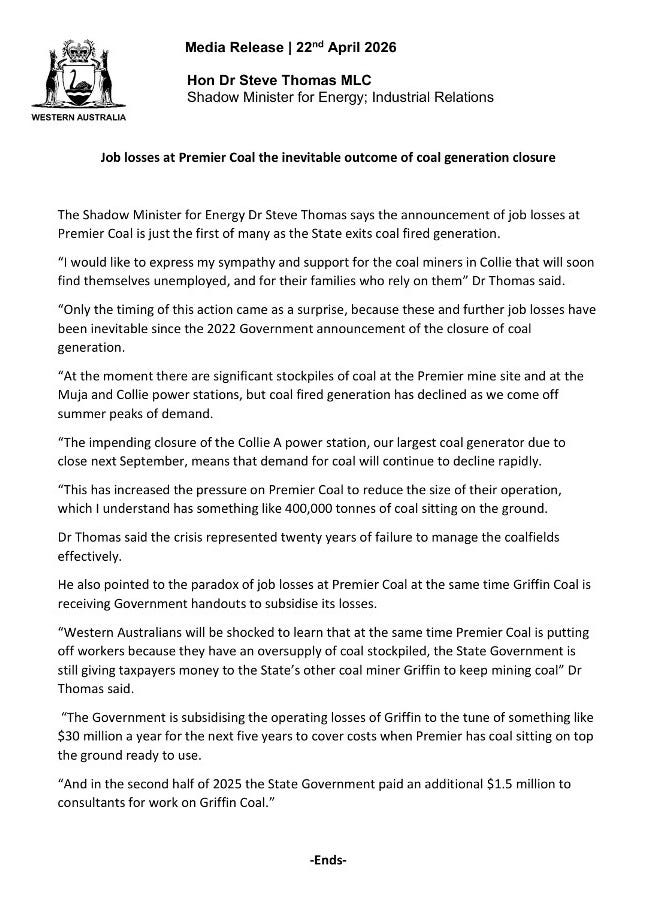
The media release by Steve Thomas on the unfolding situation at Premier Coal is not merely a political critique. It is, quite simply, a statement of fact.
And he is absolutely right.
What is now occurring in Collie is not an unforeseen disruption. It is the predictable, and predicted, consequence of a government that has pursued energy transition through announcement rather than execution, and ideology rather than planning.
At the heart of this issue lies a contradiction so stark it demands scrutiny. On one hand, Premier Coal is shedding jobs due to oversupply, with hundreds of thousands of tonnes of coal reportedly sitting idle and demand collapsing as coal fired generation is wound down. On the other, the State Government continues to subsidise Griffin Coal to the tune of tens of millions of dollars annually to keep mining operations afloat.
This is not transition. This is dysfunction.
The government is, in effect, paying one coal producer to stop while subsidising another to continue. Workers lose jobs in one operation while taxpayers fund the artificial survival of another. If this were a private sector strategy, it would be dismissed immediately. Yet here it stands as public policy.
Dr Thomas rightly identifies this as the culmination of two decades of failure in managing the Collie coalfields. But the more immediate issue is not historical. It is operational. The current government has known since its own 2022 announcement that coal generation would be phased out. The closure of Collie A was scheduled. The decline in demand was inevitable. None of this is new.
What is new is the absence of a coherent, integrated response.
Where was the demand forecasting aligned with supply management? Where was the workforce transition strategy that matched timing with reality? Where was the coordination between Premier Coal, Griffin Coal, and the state’s energy roadmap?
Instead, we are left with a policy vacuum filled by reactive spending and contradictory decisions.
This is not merely an energy issue. It is a governance failure.
The implications extend beyond Collie. Western Australia operates on a small, isolated grid. Decisions around generation capacity, fuel supply, and system stability carry far greater risk than in interconnected markets. Yet the same lack of strategic discipline is evident. The rush to close baseload generation without fully articulated replacement capacity, combined with ad hoc interventions such as Griffin subsidies, suggests a government managing headlines rather than systems.
And Collie is paying the price.
The human cost should not be obscured by policy language. These are real jobs, real families, and a community that has powered the State for generations. To treat their livelihoods as collateral damage in a poorly sequenced transition is not just economically flawed. It is morally questionable.
What makes this episode particularly troubling is how avoidable it was.
A competent administration would have aligned coal phase out timelines with mine production strategies, ensured that stockpiles did not accumulate to economically destructive levels, and implemented a transparent, credible pathway for both companies and workers. Instead, we see fragmentation, duplication, and waste.
And taxpayers footing the bill.
In any functioning democracy, such contradictions should trigger sustained scrutiny. The media must move beyond surface reporting and interrogate the mechanics of these decisions. The electorate, too, must recognise that energy policy is not an abstract debate. It is a test of governmental competence.
What we are witnessing is not the cost of transition. It is the cost of mismanagement.
Steve Thomas has articulated the problem with clarity. The question now is whether anyone in government is prepared to acknowledge it, or whether this will simply be another example of a system drifting forward, insulated from accountability, until the next failure makes denial impossible.
Collie deserves better. Western Australia demands better. And the standard of governance on display here falls well short of both.
©2026 Craig Peacock
#WesternAustralia #Collie #EnergyPolicy #EnergyTransition #Coal #BaseloadPower #GridStability #PublicPolicy #GovernmentAccountability #EconomicManagement #TaxpayerValue #IndustrialPolicy #ResourcesSector #AustralianPolitics #PolicyFailure #WorkforceTransition #RegionalAustralia #EnergySecurity #StateGovernment #AccountabilityNow #AusPol #WAPol #Credlin